Showing posts with label oil. Show all posts

Monday, March 23, 2026

Ask Not What You Can Do For Your Country

Are we at war?  Were we at war?  It's hard to tell.

News flows moment to moment, endlessly panicked, breathless, and reactive.  But if you step outside, and turn off your phone, there's not even the whiff of war.  America remains oblivious and untouched, except for a modest bump upwards in the price of gas.  There aren't shortages.  Sirens and alerts don't sound, and distant columns of smoke don't rise lazily upwards in the bright spring sky.

Nothing, nothing at all, is asked of us.  Not a thing.  

When republics go to war, citizens are generally expected to pitch in.  Grow a garden. Reduce your consumption, so the troops don't have to go without.  Be alert, at least.  But none of that is true.

Out in my garden, amongst my other garden flair...sleeping gnomes, umbrella-wielding Totoros, windmills, and the like...there's a sign from another time.  It's a bit of tin, upon which is printed a call to Garden for Victory, as so many Americans once did.  I do that, all the time, because it is, as the sign says, "thrifty and patriotic."   It's hard to be a patriot these days, because patriotism in a republic requires more than blind obedience.  Still, doing the right thing is doing the right thing.  

We are, for now, in the midst of our second war in less than five months.  We are overthrowing a monstrous regime,  but we're also not, and we're going to obliterate them, while letting them sell oil at huge profits to support their war effort, and we're killing and existentially threatening their leadership, while at the same time expecting them to negotiate.  

Given the gibbering incoherence of our addled leadership, a sentient citizen must come to their own conclusions.  Iran is, obviously, a war over oil, because the common-sense through-line between Venezuela and Iran is control over fossil fuel resources. 

And so, as I would if we were still a decent and honorable republic, I'm using less fuel, because that seems like the thing a citizen would do if they were patriotic.  It's what my grandparents did.

Yesterday, in the heat of a false summer, I did all of my necessary travelling on my scooter.  To church, and back, and then to celebrate a little one's birthday with some old friends.   The roads were full of traffic, heavy with Americans rushing about, as we always are, fat with SUVs and pickup trucks.  It was just an ordinary Sunday.

Because nothing, nothing at all, is asked of us, other than to keep spending money, not asking questions, and carrying on as if nothing is happening.


Wednesday, December 17, 2025

America Invades Venezuela

It hasn't quite happened yet.

But it's highly likely.

So likely, in fact, that in two of the last three novel manuscripts I've sent to my agent, it's a given.  They're both set in the near future, and both operate under the assumption that we've gone into the Big Sticky to liberate all that oil.  In the one I wrote in 2019, our invasion costs more lives than expected, which stirs us to build more AI systems to reduce all the pesky bad publicity.  Which, of course, leads to the robot uprising.  In the one I wrote in 2020, a vet struggles to right his life after a crippling non-combat injury sends him into a spiral of addiction.  He writes a novel that reimagines his life and injury in a heroic way, which, of course, includes aliens.  Where was he injured?  Venezuela.  Where was his alter-ego injured?  Venezuela.  

None of that sparked interest among publishers, though.   Ah well.  So it goes.

Since Venezuela discovered it was sitting on the largest remaining reserve of oil on the planet, an American invasion has seemed a possible future.  The probability of that conflict required several factors to shift, though.

First, were we able to kick our national addiction to fossil fuels?  O Lord no.  Sure, we've gotten around that as a short-term challenge.  America is now the world's largest oil producer, as we've used hydraulic fracturing to access deep new resources beneath our own soil.  But while fracking is an engineering marvel, it's also an end-stage technology.  Once we're done, we're bone dry.  That, and it's expensive.  Fracked oil is hard to get to, and requires far more work to refine.  In order to make a profit from fracked oil, the cost of a barrel of the good stuff needs to be well above seventy bucks, which puts fuel prices at a politically punitive level.  Were we playing the long game, we'd be well into the transition away from our dependence.  Efforts to begin that transition were met by howls of protest from the reactionary right, and picked up by populist hucksters, all of whom are well funded by the fossil fuel companies.  We're just as addicted as ever.  Without cheap fuel, our already tottering economy would collapse.

Second, do we as a nation have a moral compass?  Are we, in other words, a decent and honorable people?  A nation that invades another nation to take their resources...openly, transparently, obviously...isn't an honorable nation.  For decades, the enemies of the United States claimed that we're a decadent, corrupt, "imperialist" monster.   Now, we are that monster, because Donald J. Trump is precisely the sort of person who takes what he wants, morality and honor be damned.  He speaks, thinks, and acts like a mobster.  We find that entertaining, and use that to excuse the indecency of it all.

Third, what is the likelihood of success, were we to invade?  Even an amoral brute can be dissuaded by the prospect of a thrashing, after all.  Given the comparative strengths of our militaries, the likelihood is high.  Venezuela is not China.  Their military is a small fraction the size of ours, and they aren't anywhere near as well equipped.  It'd be a rout.  

At first.  Holding and defending refineries and oil production facilities in a subjugated nation with a restive population might be a tricky wicket, particularly as it'd give our geopolitical adversaries the opportunity to bleed us a little bit.  But who cares about the long term?  If we were the sort of country that had any meaningful sense of the future, we'd never have elected Donald J. Trump.

Finally, are the necessary staging events occurring?  Are we prepositioning military units?  Are we producing rationales for an invasion so that supporters of our current regime can rationalize such brazen anti-republican rapaciousness?  Of course we are.  We've assembled a strike force in the Gulf of Mexico.  We've declared Venezuela a fentanyl producer, even though they're transparently not, and declared fentanyl a "weapon of mass destruction," even though it transparently isn't.  Remember when Russia was holding "military exercises" near Ukraine?  We're past that stage.  We've started blowing things up, and seizing ships.  It's all sloppily done, of course.  Messaging from the White House is an incoherent shambles, as Dear Leader both says it's all about fentanyl and at the same time can't stop publicly drooling over the oil.  We're clearly all geared up.

So will we invade?  Not necessarily.  It's not inevitable.  I hope, honestly, that we don't, and that my stories about our misadventures in The Big Sticky describe a future that never comes to pass.

But it feels very, very likely now.

Monday, June 23, 2025

A Most Profitable War

So here's a thought, one that I've not seen pitched out in the bizjournals or propagated by the business-oblivious American Left.

As America starts dropping bombs on Iran, and Iran inevitably chooses to retaliate in the only way it can, there'll be disruptions to Persian Gulf shipping.  Iran's Houthi proxies will start lobbing antiship missiles at passing commerce.  Shia Iran will pitch ballistics at the wealthy Sunni petrostates, and we'll see burning refineries and damaged or sunk tankers.  

Even if we don't see that happen, the markets will price that potentiality into a barrel for a while.

So the cost of a barrel of oil will rise, as will the price at the pump.  That's not collateral damage.  I'm kinda sorta of the mind that this is a goal.  Meaning, somewhere, someone knows that war with Iran is in America's financial interest.

I mean, the primary goal is advancing the interests of Bibi and the Arab Petrostates, who are largely now aligned.  But as a secondary goal, rising oil prices are in the direct interest of American petroleum producers.  

Because right now, the United States of America is sitting on a huuuuuuge reserve of shale oil.  In Utah, Colorado, and Wyoming, we have the largest such reserve known to humankind.  It contains within it trillions of barrels, enough resource to keep us all burning carbon unabated for nearly a century.

But using that oil is very resource intensive.  It's a highly technical process, requiring substantial research and engineering, and thus has a far higher profit threshold than old-school oil drilling.  

If the price of oil, per barrel, is less than sixty five to seventy dollars?  Some production becomes unprofitable.  The farther below seventy bucks a barrel it falls, the more the business model for shale starts to collapse.  Below fifty bucks a barrel, it's time to shut down production.  You're spending more to get it out of the ground than you're making.

Three months ago, oil was running at $58 per barrel, meaning production was getting right near the edge of viability.

Now?

Now it's soared, up to nearly $75 a barrel, comfortably above the point at which domestic shale is commercially profitable.

For OPEC nations that traditionally drill, some losses and damage to production will be more than made up for by soaring profits.  For American production, this war could be a lifesaver.

Which is just such an odd, unpleasant business.


Wednesday, January 21, 2015

Abundance in Jamestown

It's a time of energy abundance!

So crow the pitchmen for the oil and gas industry, eager to spin the current Saudi-overproduction-driven oil glut into something wondrous.  A new age for America, part of an exciting time of expansion and growth, driven by ample new supplies of energy!  Cheap gas!  Big cars!  It's 1969 again, baby!  Abundance!

And on the one hand, taken as a snapshot of this moment in time, that is true.  But it is a strange truth, because it masks a larger reality.

That reality is that we have arrived at the shores of a new world.  It is a world soon to be devoid of fossil fuels.  Oh, we have them, now.  But within what I can reasonably expect to be my lifetime, our transportation system...and our agriculture...will have to be completely new.

This is doable.  It is, God willing.  It remains within our capacity to adapt, though every year we do not change deepens the challenge.  But the global storehouse of fossil-fuel energy is just as finite as it ever was.  The only change is that we're pumping it faster, at the same time we're flushing the last drops from the grudging rocks.  Within the next fifty years, our entire energy economy will change.  It has to, if we're to survive as a species.

Being American and all, I remember the history of our American experience, in all its mess and struggle and glory.  And that stirred in me a metaphor, as so many things do.  What this reminds me of is the experience of those first colonists.

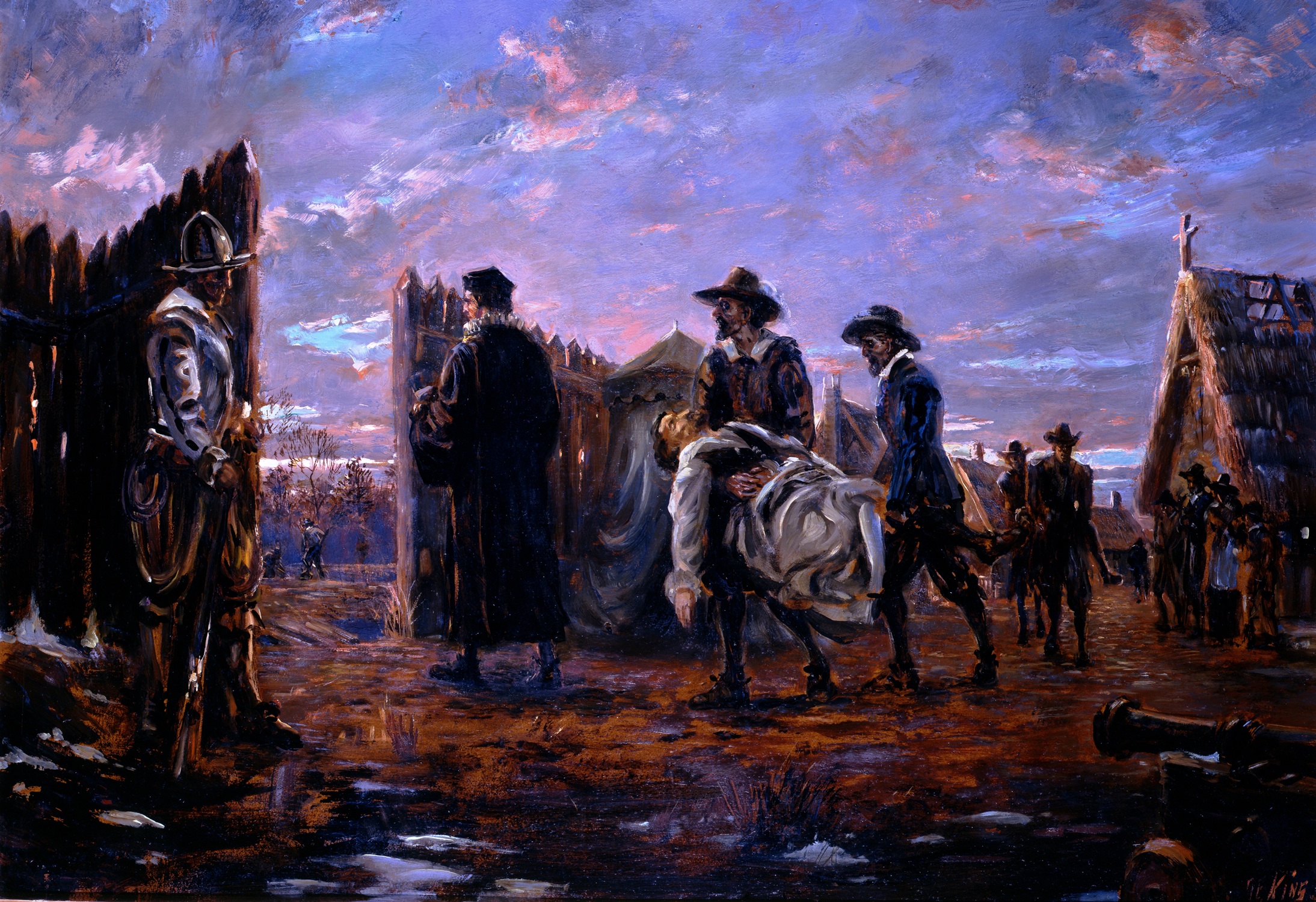
Where we are right now as a country is Jamestown, and it's the Fall of 1609.  We are those colonists.

We can't grow any more food, because the growing season has passed.   What we have in the provisions that we've brought from England and what remains from our sparse harvest will have to get us through the long winter in a new land, until we are able to figure out a way to be self-sufficient.

What the sheiks and the pitchmen, the executives and the lobbyists want us to believe is that our finite storehouse is justification for a time of feasting.  

"Look how much we've got in the storehouse," they smile, as they cut prices and tell us all to eat our fill.  "Wow!  So much!  Time for a celebration!  Yay us!  Dig in!"

Which in Jamestown, in the Fall of 1609, would have been sort of true.  But mostly not.  That colony barely, barely survived a time of hunger and privation.  Others, like the Roanoke colony, simply vanished, dying on the hostile shores of a new world.

What we are being told now is wildly unwise, the deluded foolishness of a profit-addled quartermaster.

There is no fossil fuel resupply ship.  What we have has to last.  

It has to, for the sake of our future.

Wednesday, April 11, 2012

Over A Barrel

This was intended to be a short, vaguely smug post about just how awesomey awesome it is to be a Prius-owning/motorcycle-riding pastor type in this era of high gas prices.

I was also planning on noting that what really matters is "person-miles-to-the-gallon," my way of encouraging folks who have larger vehicles to take heart in the ability to carry more than one person at a time.  

Thinking in PMPG, for example, means my schweet eco-ficient motorbike gets on average 55 PMPG.  A Chevy Suburban with one passenger?  Only 13 PMPG.  But wait!  Before we get all self-righteous, let's add someone.  With two passengers, you're at 26.  That's subcompact efficiency.  With three, you're at 39.  That's hybrid efficiency.  Max it out at eight, and you're rocking it at 104 PMPG.   Of course, the Prius with four gets 220 PMPG, but still.  Sharing is efficient.  Those moms with their kid-transport-pools are doing their part, eh?  And carpooling with four in an Escalade is just as efficient as one in a Prius.

But as I got into thinking about gas prices, and looking at historical trends, I encountered something of a fuddler.  Back in 2008, as we all remember, gas prices soared to record highs, hitting 140 dollars for a barrel of light sweet crude and spiking at around $4.12 for refined go-juice at the pump.  At the end of last week, gas prices are at about $3.88 a gallon at the pump on average nationally, and just about $102 dollars a barrel on the market.

Take a look at these charts, side by side:


They're similar, but not identical.  A barrel on the market is 42 US Gallons.  In 2008 during the price-spike, $140 a barrel meant a market price of $3.33 per unrefined gallon, which means the differential between market and pump price was $0.79 per gallon.    In 2012, $102 a barrel translates into a price of around $2.42 per gallon of light sweet crude, which means the differential between crude market and refined pump price is $1.46 per gallon.

This is a very different margin.

Key cost factors for a gallon of gas are production, taxes, distribution and marketing, and station markup.  It's not taxes at the pump.  It's not less refining capacity, because refining capacity has not decreased.  It's not higher costs for drilling, because that would be reflected in the market cost of the crude.  It's not increased real-estate values over 2008 for gas station owners and franchisees.   It can't be distribution costs for transportation, because that would have been mirrored in the 2008 price surge.  Station markup remains low.  That's just not where your average service station franchisee or independent small business owner makes their money.

On some rather basic level, meaning that of addition and subtraction, this doesn't seem to work.  Somewhere in the system, transaction costs have gone substantially up.   Not so much that the graphs aren't similar.  But there's variance there.  It seems significant.  At 9 million barrels a day consumption in the US, that's around a $200,000,000 dollar drain from the economy.  Every single day.  Even by Washington standards, that's real money.

Huh.  Odd thing.  Anyone out there more informed than I about this?

Friday, July 23, 2010

America's Always Done It That Way

America is, or so we are often told by people who should know better, a Christian nation. It's a fairly common refrain among those on the far right, those who would self-describe as ultra-conservative. They see resisting change as a battle against the forces that are gradually, insidiously turning this country into some unrecognizable socialist horror. You know, like the People's Republic of Canada. Change is to be resisted.

I found myself yesterday musing at the irony in this.

Conservatives in America tend to be church folks. And church leaders know that the kiss of death for any church comes when it is governed by one particular and pernicious phrase: "We've Always Done It That Way." As a theory for the primary cause of church demise and decay, it's well tested. If a congregation is not open to change, not open to responding creatively to the new challenges in its community and the world, then it will die. It might take a while. But that church will eventually calcify and crumble and fail, because it has ceased to be a living entity.

Here I'm not talking about changing the central governing values of the church. I'm talking about changing the structural and procedural mechanics of church. You know, the crap that doesn't matter. Big, vibrant churches...which, paradoxically, are often the conservative ones...know this. You modify the form, while maintaining the essential content.

Observing the intensity of the resistance to some seemingly obvious and necessary structural changes in our country, I marvel that a nation filled with successful churches should be so ferociously resistant to change. Take, for instance, our approach to transporting our selves and our stuff. A car-based system of mass transportation is obscenely inefficient, abusively wasteful of both our time and our natural resources. But we LIIIIKE it. It's the way we've always done it. It feels comfortable. So even though it can't be sustained, we resist any efforts to change it. Just drill more! Just make more roads...so long as you don't make us pay for them. And keep gas cheap, so we can drive our big lumbering Suburbans just the way the Founding Fathers intended.

We choose to ignore that things are changing. We refuse to realize that the easy and abundant energy that comes from carbon-based sources of energy was the only thing that makes the inefficiencies in our system possible. We close our eyes to the approaching end of the Oil Age. We are, as a culture, like that college-town church that clings to organs and stained glass and high pulpits and robes. It might, for a time, survive. But eventually, clinging to forms and structures that no longer reflect the reality around us will be the end of us. Assuming we're not dead already.

Any halfway competent pastor could tell you that.

Tuesday, May 4, 2010

Virginia's Contribution to American Energy Independence

Following the GOP's enthusiastic embrace of offshore drilling in the last presidential election, the great state of Virginia has aggressively moved to open our coastal waters to oil exploration. With the election of Gov. McDonnell, things were moving vigorously towards Virginia being 1) for lovers and 2) for drilling, baby, drilling. Not that the two are mutually exclusive, nudge nudge, wink wink, say no more. Up until a short while ago, Virginia was leading the nation in plans for gettin' more of the black gold out of the sea.

This was right up until the ongoing fiasco in the Gulf of Mexico. With two hundred thousand gallons of crude pouring daily into the Gulf from an unrepaired and apparently unreparable rig disaster, things have ground to a halt on the drilling front. For some reason, those Virginians who live by the water or make their living on the tourism generated by our beaches...well, they've suddenly realized that oil isn't always neat and tidy and out of sight.

That doesn't mean that Virginia conservatives have set down the mantle of oil exploration. It is, we hear, just as important as before. America needs that oil, if we're going to finally shake ourselves free of our addiction to them furriners and their go-juice. We can't let this little setback shake our resolve to seek new energy for America's future!

What will Virginia's contribution to energy independence be? In an article today about Virginia coastal drilling, there was a little factoid buried amidst the political posturing, one that stuck out. Total potential reserves of oil off the shore of Virginia are now estimated at 130 million barrels. That's a whole bunch of barrels! 130 million reasons to get out there and start burrowing into the sea floor!

This impressive untapped reservoir of Virginian oil will, at current rates of consumption, fuel American cars and drive the American economy for...well...for...um...err...

Six days. Six. More. Days.

Suddenly, drilling seems rather less pressing. Even if supplies are twice what's been projected, they're not going to make a meaningful difference in America's energy future. Funny how that never gets mentioned by the folks who are so eager to have rigs off the coastline of our beautiful state.