Showing posts with label good. Show all posts

Wednesday, June 3, 2026

Good is Its Name


What the lectionary this last Sunday offered up, in all of its length, was Genesis 1 and the first three verses of Genesis 2.  This is the familiar "God made everything in six days, and on the seventh, he took a breather" story.  The rhythms and patterns of that scripture rise from ancient liturgy and worship, with cycles of repeated words that appear to have been intended to be chanted or recited or sung by priests in the temple.

This story clearly affirms that Creation…all that we see and perceive…is good. It is to be viewed not neutrally, or as inscrutable and dangerous, but as essentially positive. That is certainly true of our tiny delicate little living gem of a planet, but it is also the operating presumption about the entirety of existence as we are able to observe it, all forty-six-and-a-half billion light years in every direction.

Seven times in this ancient liturgical chant, we are told that in the midst of his work, God observes it, and sees that it is good, or that it is very good.

In Genesis, the Hebrew word for “good” is one you probably know.  You do, really you do, even if you weren't required to take Hebrew in seminary.   Seriously.  You can do this.  

Just complete the following two word statement:  "Mazel _____!"

Yeah, you know it.  Tov.

The word for good is tov, as in the familiar Jewish celebratory affirmation mazel tov, which means basically “good fortune.” “Good morning,” for example, is boker tov, which is always a pleasant thing to know when you're entering your wife's synagogue for morning services. 

God sees his creative work, in all of its abundance, and affirms that all of it is either tov or…if it is very good, tov me’od.

In prepping to preach on this, I went down an unanticipated linguistic rabbit hole, one I didn't subject my congregation to when I hit 'em with the sermon.  The focus of that sermon was on the nature of work, and how God values all work in ways our blighted and grasping economic assumptions do not.  Walloping folks with an excursus on a bit of peculiar Hebrew subtlety seemed a distraction.  

I'd always considered those recurring "and God saw that it was good" statements as adjectival in nature, affirming of the character of each stage of the work of creation.  

But tov is a word that serves many functions in Hebrew, and it can be both an adjective and a noun.   In the construction of the verses in Genesis, it's phrased like this: vayar Elohim ki tov, which means, literally, "and saw God that good."   Most English translations incorporate a logically assumed "it was" into that formulation, for obvious reasons.  But in the Hebrew, that isn't actually there.  

Which means, given the sentence construction, that it could be just as easily read as the nominative "And God saw that Goodness," or "And God saw that Abundant Goodness."  Tov could be a noun here.  It doesn't have to be, but there is sufficient linguistic ambiguity that it could be.

For some reason, this struck me as delightful, as a deepening of God's affirmation of Creation, as if Goodness and Great Goodness were so essential to the nature of God's work that it could be our name for it.  It isn't a question of the Lord saying, "Yup, that's some quality work I did there."  It's an ontological affirmation that Creation is fundamentally radiant with the sacred.

If only that was how we were able to perceive it and name it, not as a thing to be used and owned and controlled, but as Goodness itself.

Take a handful of warm sweet compost, filled with the richness of life and the promise of harvest.  The name of that is Goodness.  Look up to the first star in the night sky at dusk in the late spring, and in the cool breeze of the evening, name it all as Great Goodness.


Wednesday, January 14, 2026

"Everything is on the Table"

"Every option is on the table."

What does it mean, ethically and morally, to make that statement?  There are some folks who might view that assertion as a mark of strength and flexibility, as a sign that a decision-maker is someone who will get things done.  If you set a goal, and are willing to get to that goal by any means necessary, then it is far more likely that you'll succeed.

And what could possibly be more important than success?

But the problem with this declaration is obvious.  If a person isn't willing to rule out any course of action, then they are amoral.

Good and moral people are defined not simply by what they do, but also by what they are unwilling to do.  Morality isn't just about goals, but about the means to those goals.  If I pursue a good end with evil methods, then I am evil, and the final result of my actions will be colored by my evil methods.

Still, I may reach my goal, rather than failing to do so because there are things I will not do.

In that sense, amoral and evil people have "strengths" that a moral and good person does not.

But what even is good, and what is evil, some folks might offer.  My understanding of the good may differ yours, so who is to say where the truth of anything lies?  In our amoral age, this amoral assertion passes for common wisdom.  The sons and daughters of Pilate would have us understand truth as essentially subjective, and moral action as relative.

I reject this.

I have a clear understanding of my ethical purpose, even as I recognize my failings in striving towards it.  If you are a Christian, if you make that claim about yourself, then your actions must be governed by the teachings of Jesus of Nazareth.  It's a non-negotiable.  And that constrains me.  Violence against others is off the table.  The single minded pursuit of material gain and profit is off the table.  Cruelty, lies, and manipulation are off the table.  The brute consequentialism of power and dominance are off the table. 

They must be, or we are not who we say we are.

We would become salt without saltiness, as Jesus once put it.

Tuesday, March 10, 2015

The Wrong Tree

Having watched and listened to the dear departed Carl Sagan talking about our tiny, fragile world recently, I found myself watching the next video that spooled up on that particular YouTube playlist.  I love listening to Carl, who in his gentle warmth and wonder is...to my soul, at least...so much more inviting than Mr. Degrasse-Tyson, the celebrity scientist du jour.  Or maybe I'm just cheesed at Degrasse-Tyson for his one great scientific achievement, which was leading the charge for the demoting of Pluto from its status as a planet.  Grrr.


Sagan was not a theist, not at all.  A "strong agnostic," perhaps, with the weight heavily on the doubt. Most specifically, he had beef with two things:  

First, that human beings should have the arrogance to imagine that God--should such a being exist--is like us.  For that, he relies on that passage of Genesis where the Creator of the Universe makes us "in his image."

God, a bipedal hominid?  How preposterous!  Against this idea, he recounted the writings of the ancient philosopher Xenophanes, who mocked the human propensity to create deities that resembled themselves.  If cows made gods, they'd look like cows.  When cultures make gods, they look like themselves.  How silly!  How arrogant.

Which would be fine, if that had been meant as a critique of theism itself.  Given that Xenophanes was one of the first Greek monotheists?   It's not.  

The core of Xenophanes' argument was not a critique of the idea of God, but of the absurdity of anthropomorphizing such a being.    It's the difference between Zeus and the I AM THAT I AM, between Storm from the X-Men and the One who Speaks from the Whirlwind.

So, sure, yeah, God's ways are not our ways.  We do get that, my friend.  Point taken. 

Second?  The second and more substantial thing that struck me was Carl Sagan's recounting of the story of the garden in Genesis.  In Sagan's telling, what happens in Eden is simple.  We are forbidden to eat of the Tree of Knowledge.  We are kept from truth, kept from exploration, kept from the joys of discovery.  Humankind in Eden exists in ignorance, willfully suppressed by an oppressive, controlling Deity.

In this line of thinking, the Eden of Torah may be perfect, but it is a dark perfection, in which we are denied the right to know and wonder and explore, trapped forever in a stunted, childish state.  This is recounted as an indictment against all of the faith traditions that arise from that story.  Even in our most primal story, we are oppressive, and the enemy of science. 

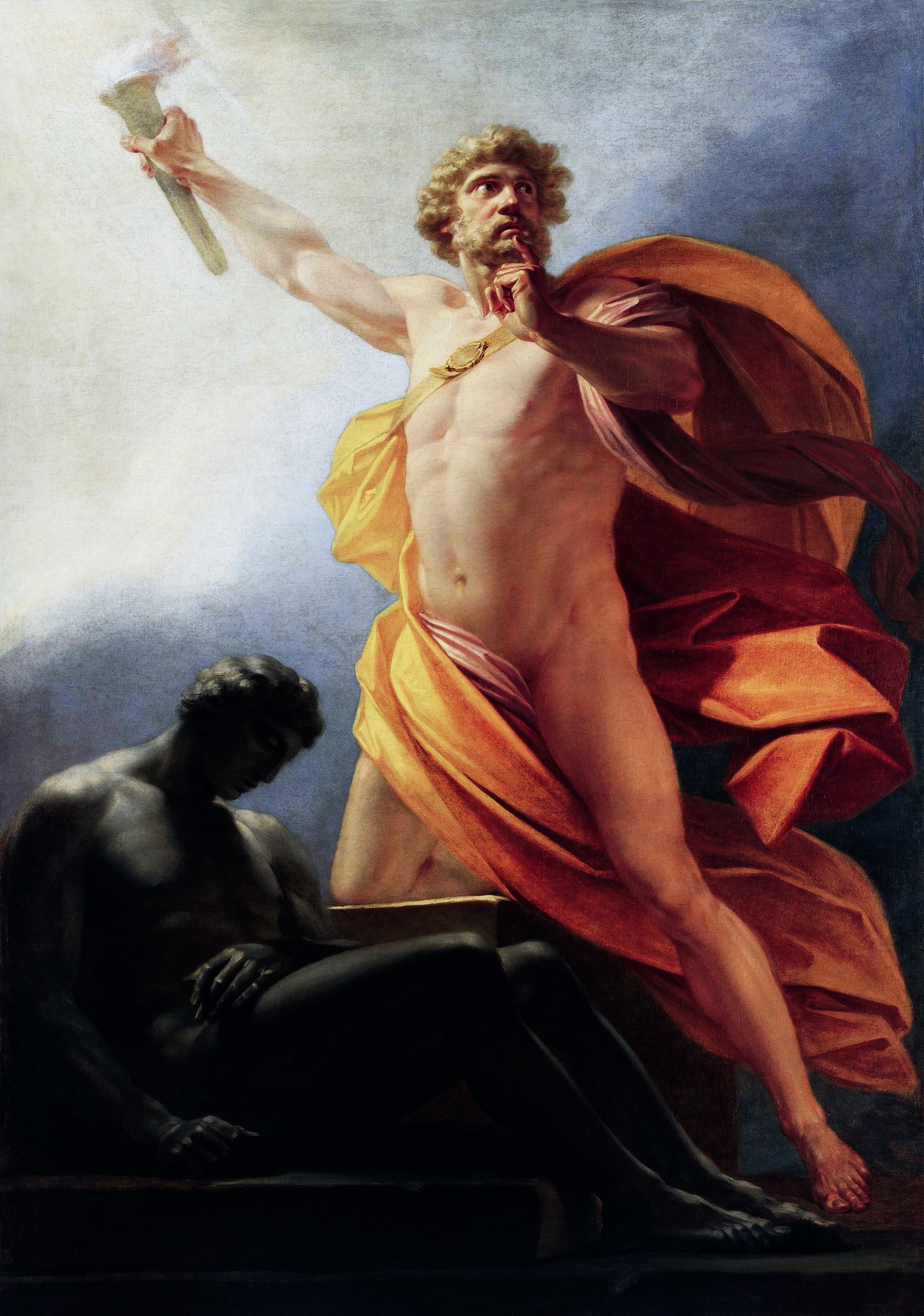
It's a familiar spin, casting out the second of the two Genesis stories as a functional variant of the Prometheus myth, with the serpent in the role of Prometheus, the giver of fire and knowledge.  In that telling, God is the dark demiurge, the one who would keep humanity eternally subjugated.  That's the take of the ancient Gnostics, who saw only malignance and oppression in the story of the Garden, and for whom the serpent is Christ.  Interesting folks, the Gnostics.

It'd be a fair critique, if the Tree that shows up in that story from Torah was the Tree of Knowledge.

But it isn't.   

In that story, the tree is מֵעֵץ הַדַּעַת טוֹב וָרָ.  
  
It is me-esh haddat towb warah, the "tree of the knowledge of good and evil."  
What the adam, which means "creature of dirt" is warned against is not knowledge itself.  Everything already exists in the garden, in a state of primal, archetypal goodness.  All that--every creature, every plant, everything--can be known, explored, named, and wondered at.  That is, in fact, stated as humanity's purpose.  It is a place of learning and delight, in which every choice is good.
The warning is against being able to know and choose evil. God knows what is evil, what is broken, what will bring woe and hatred and oppression, and chose not to place it in the garden.

Which is why the story of Eden does not involve God being really cheesed off at the ish and the isshah for drawing up the specs for an unauthorized large Hadron Collider.  
The knowledge they get from that tree is social shame.  What they have learned is not the capacity to help and support one another--their created purpose--but the ability to pass blame and recrimination.

And there, from context and purpose, I must demur from the gnostic/atheist spin on that story.   It's just not what it says, or the reason for its telling.

Tuesday, August 26, 2014

Understanding Evil

In a recent article distributed by CNN, human rights author James Dawes suggested that calling the actions of ISIS "evil" was counterproductive.

"We only call people 'evil' as a pretext for killing them," Dawes said.  And there is, without question, truth in that.  Once you have affixed that label, it's far easier to radicalize your perspective, to see only a caricature of a person.  You shroud them in your own image of them, obliterating their humanity, seeing only everything that justifies your choice to hate them.

It's how we approach our falsely binary political "system," certainly.  The Clintons were not a left of center political couple.  They were murderous jackbooted liberals who were taking away our freedoms!  George Bush was not a genial, straightforward guy with a gladhanding way.  He was a genocidal monstrous tyrant who secretly engineered 9/11!  Obama is not a centrist intellectual.  He's a socialist crypto-Muslim traitor!

It's the easiest way to engage in conflict.

Once we decide someone is evil incarnate, that becomes all that we see.  And because it is all that we see, we can fail to go deeper.  We become so focused on destroying that personification that we do not see what shaped them as a person.  So we slice away at the surface, shaving at it, poking it.  We don't go to the heart of it.

That's not to say, of course, that ISIS is not evil.  They are.  Their actions, their ideology, and the fevered mockery of faith that rules them?  All of those things must be called evil, because they are the inverse of good.  Of course, you can always putter around with academic deconstructions of the idea of the Good, but...dude.  It's compassion, love, grace, patience, kindness, and mercy.  Those things are good.

The danger of naming things "evil," according to the article, is that it causes us to view things in a binary, absolutist way.  And I'm fine with that, up to the point where Dawes uses that observation to make a binary, absolutist statement.

"There is only one good reason to denounce a group as evil--because you intend to injure them."

This is not so.  Calling out a group as evil can also mean you intend to stop them from engaging in evil.  It does not mean you are going to seek their harm, but rather, that you're still willing to ascribe moral agency to them.  Only sentient beings can engage in evil, after all.  And it is not an "injury" to prevent a person or group from engaging in monstrous actions.

Naming actions as evil, though, demands that we go deeper.  Why is this happening?  Why are individuals acting in this way?  Why is an ideology so monstrous finding fertile ground?  Dig deeper, and we find that hunger, poverty, ignorance, and oppression are the poison that brings up that bitter crop.  The more desperate or purposeless a life feels, the more likely evil is to flourish.

And when we try to understand evil, we aren't saying "tolerating" evil.  Seeing through the eyes of hate only deepens love's horror at that state of being.

That is not love's end, as it pushes to the heart of the broken other.  Compassion seeks to truly understand the heart of evil, so that we can turn it, and heal it, and end it.


Wednesday, October 9, 2013

The Pope, the Atheist, the Real, and the Good

A marvelous, heartening recent interview between Pope Francis and the editor of Italian newsmagazine La Repubblica has been making the rounds lately, and a full reading of it does nothing to diminish the smittenness many open-hearted Christians feel towards il Papa.

I had initial concerns, I'll admit.  Twitter wasn't the best format for Cardinal Bergoglio.  But he has, as they say, exceeded expectations.  Kind.  Humble.  Gracious.   He has the intellectual curiosity of a Jesuit, the personal discipline of an Ignatian, and the joyous grace of a Franciscan.

Reading through the English version of that interview is worth your time, particularly because it is an exchange between a committed atheist and a Pope that manages to be both mutually respectful and playful.

One of the dynamics that struck me in their exchange was the degree to which the Pope cares about what is real.  Meaning, he grounds the conversation in a gracious, practical mysticism.  It's an approach that views the actual and physical manifestation of mercy, kindness, and forbearance into the world as of far more importance than ideology or doctrinal purity.

This stance seems to charm the atheistic editor, as the Pope chooses not to lecture or convert, but to seek commonality of understanding.  Together, they explore the concept of the Good, with the Pope defining it...clearly and distinctly...as that which spiritually and materially expresses self-giving love for all.

The case the Pope makes, while clearly grounded in his tradition, is also one that his atheistic conversation partner is able to engage.   It's not the in-group babeling of a particular worldview.  It's a case, clear and cogent, for the material and tangible benefits of what is most fundamental about Christian faith.

What is remarkable about this is twofold.  One, how simple and self-evident this approach seems.  Of course this is what is essential.  Well, duh.

Two, how effective it is for spreading Good News.  I mean, gracious, it's so obviously good, by the wild and crazy standard that it makes the world discernably better.  The measure of the good, after all, is not that you think it's good, or that those who share your worldview think it's good, or how aggressively you proclaim it.

It's about the impacts your "good" has on your relationships with others.  If your defense of your "good" cause anger, frustration, pain, and anxiety in all those around you, chances are the thing you describe as "good" is not grounded in the Deep Reality of existence.

It is not Good with a capital Gee.


Thursday, April 11, 2013

Motorcycle Evangelism

Motorcycle evangelism is easy.

On Sunday, as spring pushed its way into the world, I fulfilled an easy fundraising obligation.   As part of a church auction back in February, I'd offered up motorcycle rides through the Agricultural Reserve around Poolesville.

It's almost 90,000 acres of low density farmland and gorgeous winding country roads, just a stone's throw away from the sprawling DC Megalopolis.  On a beautiful Sunday afternoon in spring, there's not a nicer place to ride for a hundred miles.

My little 'Zook is perfect for two-up riding.  The DL650 is light, tall, and nimble.  Passenger accommodations are excellent, with a nice flat passenger seat, decent sight lines, copious grab rails, and a Givi topbox that acts as a backrest.   You're not sitting on a hard flat four inch by five inch "pad" that is only intended to evoke the concept of "seat."  You're not crunched into that butt-out sport bike-passenger crouch like a female baboon on the prowl for a mate.  It's designed for two human beings who want to enjoy motorcycling.

And power?  It's a 650, but power is adequate, providing two up acceleration that matches a Mustang GT.

Given the hoots and laughter as I opened 'er up on Sunday, I'd say more than adequate.  As one of my sons put it, it's like having a roller coaster you can ride any time you want.

So for 20 minutes, we rode.

After the ride, the reaction was familiar.   My passenger wanted a bike.  Any sane person would.  It's  just too excellent.  When you experience it, you realize that it is inherently and self-evidently awesome. It is joyous, exuberant, and well worth doing.  Not without risk, of course, and something you need to approach mindfully.  But on a Spring day, motorcycling requires only to be experienced.  It is a Good Thing.

Which got me to thinking.  Good things, inherently joyful experiences, they speak for themselves.  Why is it that we have such trouble expressing Jesus that way?  Here's this way of encountering our world that calls us to radical compassion, to heartfelt service, and to joyous celebration.  It makes life better.   I enjoy living and sharing the Gospel just as much as I enjoy bucketing down a beautiful country road on a perfect spring day.  More, even.

It's just good, plain and simple.

Why we complicate and obscure that is simply beyond me.


Wednesday, March 13, 2013

Faith, Prosperity, and Probability

Before wandering into some reading of Rob Bell, I'm taking a detour.

My recent completion of statistician Nate Silver's book clued me in to the existence of Thomas Bayes, an 18th century Presbyterian pastor/theologian/ mathematician/ wakeboarder.  Well, the wakeboarding thing is admittedly speculative, but we know so little about Bayes.  He is largely lost to history, having left us only two written works.  Even this picture of him isn't certain.  It might be him.  It might not.   It is also possible that he looked like this.  We're just not sure.  That this image is possibly him is sort of ironic.  Why?

One of those works gave the world Bayes Theorem, the probabilistic equation that has become the touchstone for all modern predictive statistics.   Bayes Theorem helps us account for the inherent uncertainty in all prediction.  I'm not so much interested in that one, not because it's not cool, but because it's not what floats my boat.

What I've found fascinating in doing more research on Bayes is that his work on probability appears to have arisen from a monograph on the sovereignty of God.   Back when I was a lad, obscure 18th Century monographs used to be hard to find, but Lord Bless The Internet, this is now some seriously public domain stuff.  So I went out and found a free eBook version and downloaded it to my Kindle.

It's got a typically catchy 18th century title:  Divine Benevolence, or an Attempt to Prove That the Principal End of the Divine Providence and Government is the Happiness of His Creatures.

Rolls right off the tongue, doesn't it?   Not quite sure that'd pass muster at Harper Collins these days.  "You know, Tom, we've been thinking about your title.  We need something that pops.  Our marketing guys have come up with this one, you'll love it, seriously, 'God is Cool: Seven Reasons He Wants You To be Happy.'  Oh, and that picture?  Do you have something better?"

The work itself is remarkably dense, a gleeful thicket of words piled one on top of the other.  We were wired differently in the 18th century.  With some adaptation, you can get into it.  As I've begun reading it, I can already feel how Bayes thought theologically.  Honestly?  I like the guy.

One of the questions he is clearly asking himself is data related.  Assuming we want to genuinely answer the question, what metrics would be reliable measures of Divine Benevolence?   Meaning, what would tell us that God is loving and good?

What's striking is the thing he immediately dismisses:  Material blessings.  As he reasons through it, he asks himself whether the giving of rewards is an inherent sign of goodness.

The answer: No.  No it isn't.

As Bayes sees it, rewards can be given by the manipulative to curry favor, or by a tyrant to cement their power.   They are not, in and of themselves, a reliable data point informing our assessment of another being's love or compassion.   So as he develops his argument for the probability that God is good, he rejects material blessings almost outright.

Fascinating.   Perhaps someone should tell Joel Osteen.